2012/05 Western USA trip - Mono Lake |
|||||
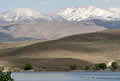 We stopped at Topaz Lake for lunch with a view across the reservoir to snow covered mountains and our warmest weather so far at over
  20C (68F).
From Topaz it was a scenic drive through the Walker Canyon until we came to the overlook of Mono Lake. From there, we had a spectacular view of the lake, cinder cones, and snowy mountains. Mono looked like just another salt lake until we got closer and could see the strange tufa columns protruding from the water.
 The story behind the tufa columns is even stranger. Mono, like the other Great Basin lakes, has no outlet, so it has become an alkali lake, full
 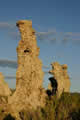 of a mixture of salts. It also has thousands of freshwater springs in the lake bed. Calcium in the fresh water reacts with the salts to form limestone, which builds up around the springs to form towers, sometimes thirty foot high. They only form underwater so they’d be invisible if it hadn’t been for the city of Los Angeles. LA had already redirected (stolen) most of the water from the eastern Sierras into the LA aqueduct and in the 1940s that was extended to the streams that fed Mono Lake. Over the years Mono Lake has dropped forty feet or more, making the lake much saltier and exposing many of the tufa columns.
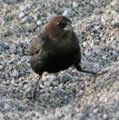
We secured a spot at the Mono Vista campground in Lee Vining and set off to South Tufa to take a look at the lake and its tufa. 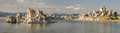 I was amazed at how busy the area was and how many different languages we heard. When we were there in 1979 we had the place to ourselves. The weather, for once, was perfect, a beautiful evening. I was still hobbling along with my trekking pole, but managed to walk to the lake shore and get a few pictures of sunlit tufa. There were too many people around to see much birdlife, but at some times of the year the lake is packed with avocets and phalaropes and gulls feasting on the weird shrimp that live in the briny water.
The irony is that there is now legislation to allow more water to flow in and prevent Mono from drying up, and the lake is coming back up. Eventually, a lot of those tufa columns will disappear back underwater and Mono will be just another salt lake, not good for Lee Vining’s tourist business.
We were still camping at above 6000 feet, even higher than Virginia City but the evening stayed pleasant. Perhaps we had finally caught up with a friendly weather system. In the morning we would drive up to nearly 10000 feet at Tioga Pass and then drop down into Yosemite Valley.
By this time, we’d been on the road for about 11 days and we were now about 2000 miles south of Hope and about to spend a week n the Sierras if the fine weather held. This seems a good point to end Part 1.