2019/04 Panama trip - Miraflores Locks |
|||||
That afternoon we were off on our own again. Alberto was taking us to the Miraflores Locks, back towards Panama City. It was slow going as it was a Sunday and the police had set up a sobriety check. We passed inspection and moved on to the locks’ museum. Alberto paid for our admission and showed us where to find him when we were done.
The first floor showed the two attempts to build the canal. The French tried first, attempting to dig a simple trench at sea level from the Caribbean to the Pacific, a similar design to that of the Suez Canal. They ran into two show-stoppers. The first was disease; thousands of workers died from malaria and yellow fever. The second was the instability of the soil; when the jungle was stripped away the hills would subside into the canal. A much smaller “angle of repose” meant that four times as much soil had to be removed, making the project infeasible.
Twenty years on, the Americans managed to minimize the disease problem, and persuaded the province of Panama to declare independence from Columbia. With three dams to raise the water levels and three levels of locks, they had a more complex design, but it required much less digging. In return for building the canal the Americans got the Canal Zone, a ten mile strip along the waterway. They realized that maintaining the jungle cover was important for the stabilization of the soil. Now, a hundred years later, much of Panama’s jungle has been cleared for farming, but the Canal Zone has been untouched and is now protected by national forests and parks. Which is why we were there.
Admission included a movie and we were expecting the story of the canal’ construction and operation, but we watched an extended scene of the peoples of Panama being terrified of Spaniards on horses followed by mostly text pages summarizing Panama’s recent history. The audience was mystified.
The next floor showed pictures of Panama’s nature, interesting, particularly the giant bedbugs, but not relevant to the story of the canal. 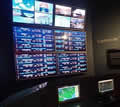 On the floor above was a good display of the canal’s controls and the job the pilots do in taking a ship through from ocean to ocean.
Finally, the top floor showed the recent expansion of the canal, additional locks able to take ships 40% longer and 60% wider. The new locks have side basins that reduce the amount of fresh water lost when ship transits the canal.
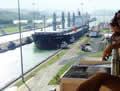
Up on the observation deck we watched a bulk carrier being towed through a lock by “mules”, electric locomotives. There was a constant and loud commentary in English, describing the ship’s transit through the lock as if it were an exciting athletic event.
 |
Miraflores Locks (8.21) |
 |
|---|
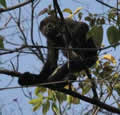 There was another suspension bridge close to the locks, and visible from the top of our Tower. Likewise, as we drove back towards the Tower we could see it poking out from the top of Semaphore Hill. Up on the hill, a troop of howlers were making their way above us in the canopy.
|
Howler monkeys (0.42) |
 |
|---|
When we got back Igua asked us what we thought of the movie. “Garbage!” I said and he laughed and said he agreed. The previous movie had been a factual history and he said he didn’t know why it had been replaced but said he’d pass our opinion on.
We had new guests, Amanda from a Toronto travel company, reviewing the Tower, a plum assignment for a birder, and Jim and Stephanie from Arizona.