2018/07 Arctic Part 2 - Inuvik |
|||||
 Friday July 6th
We woke late to a gentle rain and got on with the day’s business, moving to another site as ours was reserved, filling with water, dumping sewage, and cleaning handles so we could get in and out without touching mud. Inuvik was wet but warmer than Tuk.
When we parked at the Visitors’ Centre the first question we got from other travelers was “How did that happen?” They were looking at our mud pack. We were there to look at the centre’s art and history exhibits, but most people wanted to know about “the road”. We’d arrived at the same time as the campers who’d stopped at our stricken truck and wished us luck. They were glad we’d made it OK and he said that it was the most 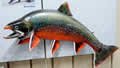 frightening drive of his life. I thought that was a bit of an exaggeration; falling off the road would be inconvenient and very expensive but not life-threatening.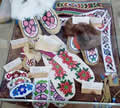
The fish is a char, a colourful Arctic cousin of the salmon. I remember the exhibit from our last trip, also the beadwork and 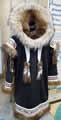 the parka. They’ve been kept in good condition.
I left a comment card at the centre. Our saviours from the power company had called the Dept of Transportation to ask if there were any tow vehicles available, and the department hadn’t even been aware that there was a problem with the road. In my comment I pointed out that the government was promoting tourism to the Arctic and that there were people from Europe who’d be getting off a plane, renting a motorhome, and heading for Tuk. If the road can’t be fixed then the very least they could do is make sure there’s a tow truck in Tuk capable of hauling a motorhome back onto the road.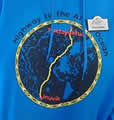
We tracked down a souvenir store (hidden away inside a warehouse) and bought a couple of unexciting Inuvik tee-shirts. I told the manager that we’d also like to buy a copy of the fleecy she was wearing, a more inspired depiction of the road to Tuk. She said it was one of a limited edition made to celebrate the road’s opening, and I was the fourth person that morning to offer to buy.
She said that her husband drove for the post office and that he’d gone off the road 3 or 4 times; he said it was more dangerous than the old ice road.
We ate lunch in the park and then went to the library for its Internet connection, which was free but only adequate for e-mailing text, not pictures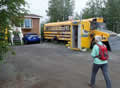
We’d heard about the reindeer chili at Alestine’s, so that’s where we went for our only restaurant meal of the trip. We’d also heard that they’d run out of chili the previous evening so we were there when they opened. The kitchen is in the school bus. There are only four tables; be prepared to share and talk. We shared with a couple from Sudbury, Ontario. They had come to drive their van to Tuk but the horror stories had changed their minds. We had reindeer chili poutine. Amazingly good. We finished just in time to walk across town to join a church tour.
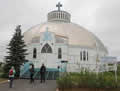
Inuvik’s most famous structure is its Igloo Church. A member of the congregation told us the history of both Inuvik and the church. Inuvik was 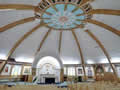 built to replace Aklavik, the previous regional centre, which had limited space and was prone to flooding. Inuvik now has about 3000 residents, declining in recent years since exploiting the area’s gas fields proved to be too expensive.
Town and church were constructed in the late 1950s, long before the building of the Dempster Highway, so all components had to come in by barge, probably from Hay River, the terminus of the Mackenzie Northern Railway, across the Great Slave Lake, and then down the Mackenzie River. (Explored on our 2013 trip to the Northwest Territory around Yellowknife.)
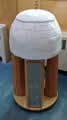 The Igloo Church was the inspiration of a Catholic pastor and the product of a brilliant but untrained architect, a brother of the church’s Oblate Order. They wanted a building more appealing to the Inuit than the usual boxy church. To keep costs down they used windows from another church and ended up with the current blending of styles. They even used old hockey sticks to make some of the gratings. I’m not sure what to think about the igloo font; it fits the theme but looks like a piece of Santa Claus décor.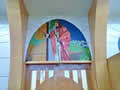
The church has two shells, exterior and interior. The interior is equally impressive, with a view of the massive wooden ribs. It has near-perfect acoustics and hosted a concert by the Canadian tenors. The striking paintings of Christ were all the work of a deaf-mute Inuit teenager, Mona Thrasher, now famous for her subsequent depictions of the vanishing Inuit way of life.
We were shown a video of the space between the shells; better than climbing up to see it ourselves. The church didn’t have access to the pile driving machine so they designed their own permafrost foundation, using layers of air and gravel and a concrete raft.
 |
Igloo Church (0.45) |
 |
|---|
The church cannot be allowed to freeze so the heating system keeps it at just above freezing point, only being warmed up beyond that for Sunday service. Even so, heating costs $3000 a month.
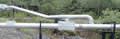 The rest of Inuvik’s buildings are on piles. Originally they were of wood, but those began rotting out in the early 2000s so now they are of steel. The buildings are connected to city sewer and water, but not under the ground as that would melt the permafrost. Instead there are ”utilidors” carrying fluids above ground; continually circulating water prevents freezing. Older buildings have larger rectangular pipes, perfect as a kids’ playground.