2018/07 Arctic Part 1 - Eagle Plains |
|||||
Monday July 2nd
We had a cloudy and cool morning. We set off up the highway, following a ridge that is part of the continental divide; to our west all streams are part of the Yukon watershed, flowing into the Bering Sea. To our east they are part of the Mackenzie watershed flowing into the Beaufort Sea and the Arctic Ocean.
From now on there is almost continuous permafrost. Any structure which conducts heat is a problem. Paths conduct heat and melt permafrost so the trees on either side will fall sideways forming a “drunken forest". Roads will sink unless the roadbed is thick enough to insulate the ground and protect the permafrost. Roads are often built as much as eight feet above the tundra, with little or no shoulder so it’s all too easy to fall off the road and roll into the tundra.
Buildings will also sink, particularly if they are heated, unless they are built on piles driven through the permafrost onto solid ground.
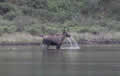 The area we were in is called the Blackstone Uplands. We came to a lake where we spotted some ducks and a
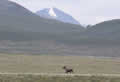 pair of tundra swans, and then realized there was a moose feeding in the water behind them. Other people stopped and the moose took off, giving us this picture of it trotting against the mountains.
 |
Moose (0.27) |
 |
|---|
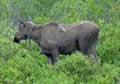 On the other side of the road were two more moose though we only caught this one with the camera. Appropriately enough the lake is called Two Moose Lake.
We were passing through magnificent mountains, the Ogilvies, great blobs of limestone with the surface fractured by frost so that they looked like piles of rocks, no strata to be seen.
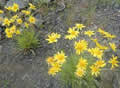 There was little plant growth on these mountains, just patches of lichen, but there were pockets of arnica along the roadside to give some colour.
We passed Windy Pass summit and began our descent. One of the signs had commented that apart from the road, this area was had been unchanged for 100000 years. It had looked the same when the first Americans had walked out of Asia. Except that they were probably hunting mammoths and we hadn’t seen any!
Drizzle began and the mountains disappeared into the clouds. The road was muddy but quite firm.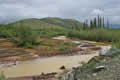
We were driving alongside Engineer Creek, a wide boulder-strewn creek with flowers growing in its gravel bars. From its width I’d guess it would be full and roaring in the spring but now it was just pretty.
All that changed when Red Creek and similar streams poured into it. These were stained red and stank of sulphur; acid from hot springs was dissolving iron oxide in the shale. The water had a weird colour and the rocks at the edges of the creek were stained an orangey-red. Not a place to fill your water bottle!
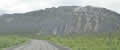
We came to a large limestone cliff named Sapper Hill, after the Royal Engineers who built the bridge over the 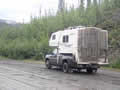 Ogilvie River. We stopped there and found that the road seemed to be covered with black glue; my feet stuck to it, and the back of the camper was coated from bottom to top. I had trouble finding the lock and then had difficulty turning the key because of the goo inside.
We followed the Ogilvie River for a while and we had trees again. There is no surface-level permafrost around the river and there’s enough topsoil to support tall trees like white spruce.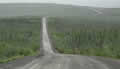
However we climbed up onto the Eagle Plains where we were back into permafrost and tundra. We could see the road twisting and turning into the distance, following the contours of the hills.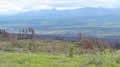
We stopped at Gwazhai Kak, an overlook of the valleys of the Ogilvie River and the Peel, which we’d be crossing in another day or so. The rain became heavy, obscuring much of the distant Ogilvie Mountains, so we’ll save most of the views for our trip back.
By the time we reached the Eagle Plains Hotel we had lightning and rumbles of distant thunder. The hotel is what the Australians call a roadhouse: a hotel, bar, campground, and service station, surrounded by wilderness. Apparently it’s located on a rare outcropping of solid rock so they didn’t have to worry about permafrost and were able to build without piles.
We went to fill up with diesel, but I couldn’t find a diesel pump, just a nozzle attached to a collection of tubes and gauges and what might have once been the insides of a pump. The guy came out of the office to fill us up just as the rain came down in a torrent. I told him that we weren’t in a hurry and could wait for the rain to stop, but he insisted on filling the truck. I sheltered in his office. As he squelched back to the office the rain stopped!