2016/05 Europe cruise - Regensburg |
|||||
 Dear All,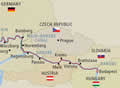
At the end of part 2 we had traveled from Amsterdam up the Rhine and Main rivers and through the Main canal to its highest point just east of Nuremburg.
Sunday May 15th
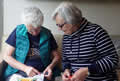 The day was sunny but even cooler; we were down to 8C (47F). We were still traveling at breakfast time, going down the locks now. Somewhere in the night we had left the canal behind and we were now descending the Danube. We were busy writing postcards and had to get them mailed soon, before we left Germany and had to buy Austrian stamps. Sandie was working on one of her projects, guaranteed to attract the ladies’ attention; this is Diane, from Wales.
That morning, Frank, the hotel manager, was conducting what he called a twisted quiz. For a large guy Frank’s laugh is odd, a hysterical giggle, and he was doing a lot of giggling. A typical question was “What was the American president’s name in 2003?” The answer was not George Bush but Barack Obama. His name was the same in 2003. Twenty questions like that. Twisted indeed.
Our approach to Regensburg was similarly convoluted, diverting into a canal and finally backing into a mooring close to its famous stone bridge. The 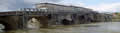 bridge is over 800 years old and over a thousand feet long, an amazing piece of engineering for its time. Of course it wasn’t built with the dimensions of modern barges and cruise boats in mind; hence the need for a bypass canal. Sadly for us, the bridge was under repair, and the spectacular view of the bridge with its backdrop of medieval Regensburg was marred by acres of poly sheeting and a
 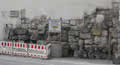 temporary foot bridge. I’ve included a picture just to show the scale. Crusaders rode across the stone bridge on their way to the Holy Land.
After lunch the crew set about reconstituting the sun deck and we set off on a walking tour with our guide. First stop was at the remains of a Roman wall; the Danube was the northwestern limit of the Roman Empire. In more recent history Regensburg was the birth place of retired Pope Benny Ratzinger.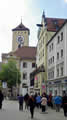
Regensburg was little touched by the war so its medieval buildings and alleys still survive. With its riverfront and hill and cathedral it’s similar in 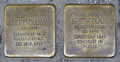 geography to the other towns we’d visited, but it looks very different. The buildings are mainly stone, giving it an almost Italian look.
Like some other German towns, Regensburg has miniature and personalized holocaust memorials, brass bricks that are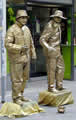 embedded in the sidewalk outside the victims’ houses, possibly the points where they were taken away by the Gestapo or SS.
These guys in the gold suits and paint are posing as statues and begging for money, an increasingly common business in tourist towns. 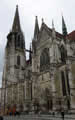 They weren’t very good at it but they got a loud scream out of a passer-by when one of them spoke to her.
 |
Regensburg statues (0.17) |
 |
|---|
 |
Regensburg |
|---|
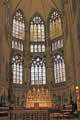
We visited the cathedral, St Peter’s, impressive outside of course and nicely decorated with some doggy gargoyles, but very dark inside, emphasizing the blaze of colour from the stained glass. Maybe it was the darkness but the cathedral had a different 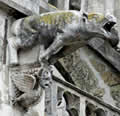 feel about it, more foreign than the other churches.
Once we’d acclimatized to the darkness, we could see the gold and silver adorning the altars, almost glowing in the light of those stained glass windows. One unusual touch is the statue of a smiling angel; you don’t see many of those.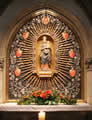
All the churches and cathedrals we’d visited on the trip had been Roman Catholic. Although Martin Luther came from Saxony, now part of Germany, most Protestants and Lutherans live in the north of the country, and Southern Germany is 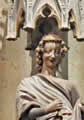 mainly Catholic.
Most of the town was closed as Germany’s Sunday trading laws are strict, but we found a place to mail our postcards, and then dived into a coffee house to get away from the cold wind.
Later that evening the Ingvi set off down the Danube for Passau, our last stop in Germany.