2014/01 Chile trip - La Campana |
|||||
Wednesday January 22nd
This was my seventieth birthday and I had wanted to do something more memorable than ambling around a city. There are a few national parks around Santiago, but they aren’t reachable without private transport, and I wasn’t too keen on renting a car and driving it on some gravel road into the mountains. Actually, to be honest, that sounded very appealing but not when we had a plane to catch the next day!
 |
La Campana National Park |
|---|
Instead I’d contacted Pedro, a guide who takes tourists into the parks to hike specific trails. I’d suggested Campana park as it looked to have a selection of shorter trails and varied terrain. Pedro warned us that the parks are extremely hot in January and that we’d be his only customers on the trip, and having to pay his minimum rate. It all sounded pretty good to us.
 Pedro collected us in his van before breakfast on a slightly overcast morning and headed north out of Santiago on the Pan American Highway; that’s the one that goes all the way north to Columbia before falling into the Darien Gap, though we only followed it for a couple of hours. Pedro is in his sixties, has lived around the world, and speaks good English. He was eager to make our day enjoyable.
We passed through valleys of vineyards and orchards, with plantations of avocado clinging to the upper slopes.
 Off to the east we had fuzzy glimpses of the Andes, including the snows of Aconcagua, the highest mountain in the Americas, which is just across the border in Argentina. We passed signs for Llay Llay – an Indian name, pronounced YyeYye, says Pedro, correcting me.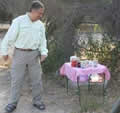
We turned east and passed through some pretty villages, passing one gorgeous cactus garden, which looked to have specimens from all over the Americas. We arrived at La Campana park and found no other people in sight, not even t he park rangers. Pedro brought out a table and served us breakfast, also giving us each a bag of food to carry until lunchtime.
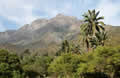
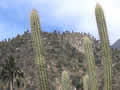
The central feature of the park is La Campana, a bell-shaped mountain, large enough to be seen and named by an exploration ship in the Pacific. The terrain is similar to Arizona’s mountains. The most striking plants for us were the Chilean palms and the quisco cactus. The palms are massive and tower over everything else. In contrast their fruit is a fingernail-sized coconut, edible but you need a lot for a dessert. Their downfall is their sap which can be used to make palm wine; many forests outside the parks have been cut down.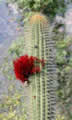
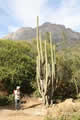
The quisco looks like a cross between the saguaro and the organ pipe cactus of Arizona. Some of the bigger plants had an attractive red fuzz coating the arms; we assumed it was some kind of flower but were told that it is a parasite and will eventually kill the host plant. But, as you can see, the dead quisco acts like a nurse log for the next generation.
Surprisingly there were no other kinds of cactus in the understory, not even the prickly pears we’d seen elsewhere. Pedro gave us a tour of the other shrubs, some edible, some scented like peppermint, most spiny. There was the chagual, similar to the yucca and sotol. Pedro taught us the Chilean names and we passed on the Mexican names for similar plants in North America.
 |
La Campana (4.49) |
 |
|---|
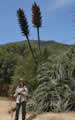
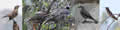
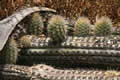 We opted for a series of short hikes to viewpoints and to our lunch stop beside a tiny stream. We saw no other hikers, just a pair of rangers and a mountain biker. “Chileans don’t visit their parks,” said Pedro; he was an exception. The most recognizable birds to us were the California quail, introduced long ago, but we also saw giant hummingbirds and an assortment of tyrants and sparrows.
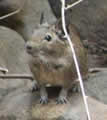
 Chile has skunks and armadillos but not in this park. Apart from cows and horses, “strays” from adjacent farms, the only animals we saw were these tiny llacas, a kind of possum.
The trails were quite rugged and we were glad that we’d brought hiking boots and poles. We should have used more 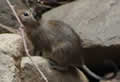 sunscreen as we got fried by the afternoon sun. We hiked until late afternoon; I think Pedro was surprised that we kept going.
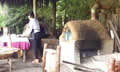
On our way out of the park we stopped at a cafe for a beer and empanadas, baked in these clay ovens. These are meat pies with an olive in the centre. They went down well. We fell asleep on the way back but luckily Pedro didn’t. He was kept busy dodging pedestrians; they’d emerge from the fields and sprint across six lanes to a bus stop. There are footbridges but not enough; Pedro said that they all fell down in the 2010 earthquake.
Back at the hotel we enjoyed our last evening on our patio but then had to pack for the next day. It had been a good birthday.