2012/05 Western USA trip - Death Valley |
|||||
 Tuesday June 5th
The bathroom was dry by morning, but my shower flooded it again. It was still windy outside but there was no sand being blown around.
The upper reaches of the Kern Canyon are quite scenic. We came upon thousands of weird-looking trees, like something out of a Dr. Seuss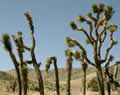 book. John and Edna thought they were probably Joshua trees; they’d seen them when they visited the LA area back in ’93. They turned out to be right, so we crossed Joshua Tree national park off our list. I’d thought that the park was the
 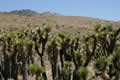 only place that had them. Getting there would have involved a big detour, so this simplified our route.
After a long descent from the mountains we rejoined Highway 395, heading back north towards Mono Lake and Reno, battling a very strong crosswind. It was a relief when we turned east at Olancha, traveling along the south shore of Owen’s Lake. Lake? Well it was a hundred years ago, a lake big enough for a mine company to run a steamboat across it, but that all changed when Los Angeles diverted all the streams into the LA aqueduct, and the lake steadily dried up. It was damper though than I remembered from our 1979 trip. The dust left on the lake bottom was very nasty stuff and I believe that there has been some legislation to keep the lake wet and stop the dust storms.
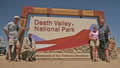 It’s a tough road through Death Valley, climbing up to nearly 5000 feet and dropping back down to sea level at Stovepipe Wells and then back up again on the exit towards Nevada. From the high spots we could look down into valleys choked with sand dunes and others with bone-dry river beds or salt flats. The scenery was not pretty, but mostly grand and stark. We were lucky, having a relatively cool day, with 20sC (70F) in the high spots and around 35C (90sF) at sea level. Even so, the campgrounds in the valley are closed in summer as Death Valley doesn’t cool down at night, even though it’s a desert. It’s something to with the air being compressed as it flows down into the valley.
Most people think “sand” when they hear the word “desert”, but flat sand is a rarity in the desert. These pictures show the different scenery we encountered on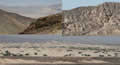 our way into the valley. The flat areas, the valley floors, are mainly salt, from evaporated lakes. These are extremely hot and shimmer in the sunlight, sometimes forming water-like mirages. Nothing grows on the hills and they are heavily eroded with rocky washes at their base, where bushes and cacti tend to grow. There is sand, but it’s pushed around by the wind and it forms dunes, sometimes hundreds of feet high.
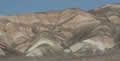 We were going to brave the valley’s sights and temperatures the next day but we wanted a cool place to camp. Fortunately, the park is
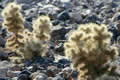 enormous and includes hills and mountains as well as the valley proper. We took the North Highway up to Mesquite Springs, with lots of stops for new flowers and cacti, like these cholla. The hills looked similar to those in the Badlands. The whole area around the road is a wash, which means that it occasionally disappears under a flash flood and gets resculpted.
Mesquite Springs is at about 2000 feet, so it was just very warm there in the sun but with a strong wind keeping it cool. John and Edna and I climbed down into the river bed and went for a walk. We met a jackrabbit, which is actually a hare and much larger than a rabbit, but we have no pictures as the light was almost gone. The walk was longer than we’d intended as the river banks were nearly vertical and we needed to find a collapsed bank that we could use to climb out. By the time we found one it was completely dark and we tried to follow the bank back to the campground. Three people wandering through Death Valley in the dark; what could possibly go wrong? We were lucky that we avoided both cacti and snakes.