2006/05 NZ trip - Piha Beach |
|||
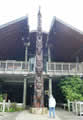 We left the towns behind and began climbing into the Waitikere Range, one of Auckland’s regional parks, and came across the Arataki visitor’s centre, full of Maori carvings and stuffed animals. After generations of losing their art, the Maori have started carving again. They have something similar to totem poles, telling the family’s history, and the figures are covered with tattoos that tell more of the story. The figures are not quite human; for example, some have only three fingers, as the carvers are not supposed to create humans and compete with the gods.All the male figures are very well endowed. Clearly, for the Maori, size is important.
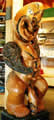 Before the first humans (the Maori) arrived a thousand years ago,
 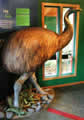 New Zealand had a very strange mix of animals. The birds dominated, with the moa, like a giant ostrich 11 feet high, and a great eagle, with a 7 foot wingspan. There was only one mammal, a tiny bat. There were many flightless birds, but now many of those, like the moa, are extinct as they couldn’t compete with the humans, and the rats and cats and dogs and sheep that came along with them.
The ranger asked how we had found the place as he said he gets more visitors from overseas than he does from Auckland. I told him “Internet”, but to be honest I’d found Piha on the Internet, and found his place by accident.
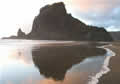 Piha is at the end of a steep, narrow road that drops down to the seaside. The seascape is dominated by the enormous Lion Rock, which protects the town from the big waves rolling in off the Tasman Sea. We camped on the Piha Domain, a flat grassy area alongside the Glen Esk River. The campsite
  was full of elderly British-style caravans, mostly unoccupied, as this was their off-season. The lady owner was happy to see a customer, and gave us an off-season discount.
There were strange birds pecking their way around the 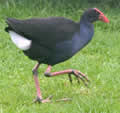 camper. They were the size of chickens, but with blue feathers and orange beaks. These were pukekos, relics from the days when birds dominated the islands.
We just had time to walk down to the beach before dark. We could see half a dozen black clouds out over the sea and these were squalls which came ashore, one by one, each giving us about ten minutes of very wild weather. We could barely make headway against the wind, and were blasted by wet sand, a new experience! As the beach was a mixture of light and dark patches of sand, the swirling effect was quite pretty, but difficult to appreciate with an eyeball full of grit. By the time we got back we were totally jet-lagged (seventeen hours ahead of Minnesota) and barely managed to cook dinner and assemble the bed before collapsing into it.