2006/03 Southwest USA trip (AZ-MN) - White Sands national monument |
|||
Although we were in rain, the sun seemed to be shining on the distant mountains and the other side of the valley, so we left Oliver Lee and drove back to White Sands. Originally this whole area was sea bed and that’s when the gypsum deposits were laid 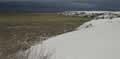 down. Gypsum is the mineral used in making plasterboard and sheetrock. Eventually, as the area rose above the sea, the Tularosa Basin dropped and the Sacramento Mountains were pushed higher. The gypsum eroded out of the mountains and was washed into lakes in the basin. Now that the lakes are drying up, the gypsum is being blown into hundreds of square miles of dunes by the prevailing southwest winds.
 At the edges, the dunes move slowly enough that plants can adapt. Yuccas can grow up fast enough to stay above the
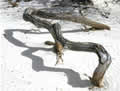
  encroaching dunes and survive on top with a 40 foot root system, but by an odd twist, as the dune moves past the yucca it no longer has the dune’s support and it will fall over and die. Even trees like cottonwoods can survive on the edges of the dunes, though they end up gnarled and twisted like the one to the left. In the centre of the dune field, though, the dunes move too fast for the plants to adapt, as much as ten feet a year, so few plants can survive, and the dunes are bare and a blazing white.
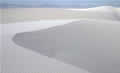 The monument seems split between being an educator and an entertainer. There are displays and nature walks around the edges of the dune field. Inside the edges, the dunes are for playtime and there are hundreds of people climbing the dunes with their snow saucers, only to zoom back down the steep leeward slopes.
The dunes move fast enough that the roads have to be ploughed to keep them open, so the impression to a Minnesotan is of 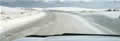 driving across a frozen lake with chest deep plough windrows along the roads, and the surrounding hills deep in snow. Except, of course, that the temperatures are in the high sixties!
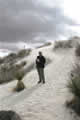
I walked into the backcountry behind the skiers and sliders, and climbed one of the tallest dunes. The gypsum feels a lot softer 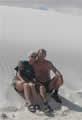 than sand, and is just like the residue from a wall remodeling project. The wind was screaming over the dune, and I could see the little gypsum grains bowling along and over the cliff on the dune’s leeward side, moving it northeast a
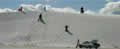 fraction of an inch each day. Eventually the dunes will cross the basin and pile up against the Sacramento Mountains, some twenty miles away. Just like in Minnesota’s snow it’s really hard to get some idea of depth when the sand is moving in the wind and it’s all too easy to step off the top of a sand dune and drop fifty feet to the bottom.
We stopped in a warm and quiet spot to take some pictures of us in shorts in the “snow” for our next Christmas card.