2006/02 Southwest USA trip (NM-AZ) - Pueblo Creek |
|||
We were heading north and to a higher elevation so it would probably be getting colder. New Mexico’s weather reports had showed places in the north like Santa Fe and Taos and the Grand Canyon consistently 10-15 degrees colder than those in the south, and way below freezing at night. We’d decided that we’d stay close to the Mexican border on this trip and that those colder parts of New Mexico and Arizona could wait until a future spring or fall trip. This destination in the San Francisco Mountains was about as far north as we wanted to go.
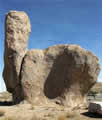 We stopped for lunch at the City of Rocks state park. These aren’t Sandie’s kind of rocks. These are house-
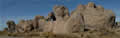 sized, with some as much as 50 feet high. They are the remnants of a volcanic ash flow, million of years ago. These are the large hard lumps left when the rest eroded away. The New Mexico park service has built trails and a number of really different camp sites within the City of Rocks. We’ll probably stay there on some future trip, but we wanted to get to the mining site by that evening, so we moved on.
The road climbed into the hills past mining businesses, copper, silver, vanadium mines and smelters, even a smokestack bearing the name “Kennecot”, the same as the famous mine in Alaska’s Wrangells that we didn’t quite get to last summer.
We crossed the continental divide at 6300 feet and then dropped down into a valley to the west of the Mogollan mountains. This is dry, high country with lots of juniper bushes, very different from the desert plains we had been in to the south.
We turned onto a narrow, winding forest road that took us into the Apache-Sitgreaves national forest and the San Francisco Mountains. This was yet another change in scenery, as this is ponderosa pine forest, with large trees towering over us. We found the Pueblo Creek campground and its log book showed that we were its only residents in the last week. A nearby bridge still had a coating of ice and snow, so our guess was that we were in for a freezing night. Our sewer tanks hang below the camper body so they are vulnerable to freezing even when the camper furnace is running and keeping us warm. Not that a frozen sewer tank is a big problem; it’s a burst and defrosted sewer tank that can spoil your day! So we dumped RV antifreeze into the tanks, and we also turned on our electric tank heaters, though those tend to discharge our batteries.
Late in the evening there was a loud bang and something hit the side of the camper. This region has bears, mountain lions, and newly introduced Mexican wolves, so we decided to investigate in the morning!
Monday January 30th
It was twenty degrees in the morning, definitely a cold night, but we had blue sky and not a breath of wind, so it was going to warm up quickly.
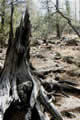 We were camped just above Pueblo Creek, which had no running water, just a few pools, iced over in the early morning. We had a map of the collecting area, and we just had to cross a couple of “washes”, completely dry stream beds, and follow some trails up the hill. We were looking for rhyolite, a rusty red volcanic rock, which had many small bubbles as it cooled and set hard. Over millions of years, crystals of labradorite had formed in those bubbles.
The only way to find the crystals is to take boulders of rhyolite and whack them with hammer and chisel. There is 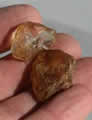 some fascination in being the first person to ever see within a rock, but this palls after the first hundred rocks or so! There were plenty of crystals but they were mainly small and quite soft, so they tended to break up easily. After working all day we had just a few crystals large enough for Sandie to facet.
It was a good day, though, for some camper maintenance, fixing a leak in the bathroom, and reattaching one of the straps that holds the sewer tank in place. I climbed to the top of the hill, far enough to be able to see the rest of the San Francisco Mountains, stretching out to the west and the state of Arizona.
As we walked back down the hill in the twilight and through the wash we could feel the cold already creeping into the low spots. It was going to be another cold night.
We hadn’t seen anyone all day. A single camper came along at dusk pulling a trailer, but he passed us by so we still had the campground to ourselves.