All we had to do was follow
Debbie's directions in reverse, but we still ended up exploring some
new roads and neighbourhoods. Once we'd found Verona again, we mailed
the copies of Alaska part 2 from Verona's post office. Then we were
back on the freeway to bypass Kingston and get onto the Thousand
Islands Parkway, which runs along the north shore of the St Lawrence
River. Yes, the "Thousand Islands" really exist; they are
not just a salad dressing label. There are actually more than a
thousand of them and they are part of the Frontenac Arch, a famous
geological entity that links the Canadian Shield with New York's
Adirondack Mountains. They are also part of the St Lawrence Seaway
that links the Great Lakes with the Atlantic, so occasionally you can
see a large ocean-going ship sliding between the islands in the distance.
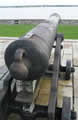 Partway along the parkway at
Mallorytown we came to the St Lawrence Islands national park. This is
the only part of the park on the mainland and most of the park is out
there on twenty of the islands. The museum was closed for winter, so
we moved further downriver, and came to the memorial for the Battle
of Crysler Farm. This isn't one that's talked about much in the USA
as 800 Brits beat 4000 invading Americans. In fact, the whole war of
1812 is invisible to the American schools' history lessons. On the
other hand, I don't remember hearing anything about the American War
of Independence in English schools either!
Partway along the parkway at
Mallorytown we came to the St Lawrence Islands national park. This is
the only part of the park on the mainland and most of the park is out
there on twenty of the islands. The museum was closed for winter, so
we moved further downriver, and came to the memorial for the Battle
of Crysler Farm. This isn't one that's talked about much in the USA
as 800 Brits beat 4000 invading Americans. In fact, the whole war of
1812 is invisible to the American schools' history lessons. On the
other hand, I don't remember hearing anything about the American War
of Independence in English schools either!
 Next door to Crysler Farm is the
Village of
Next door to Crysler Farm is the
Village of  Upper Canada, a collection of old buildings from the St
Lawrence valley. It looked interesting, but it was priced as if you
were going to be there all day, and it didn't look that different
from what we've seen elsewhere. We needed to find a campsite and we
chose the bird sanctuary on Nairn Island. The sanctuary had massive
flocks of Canada geese, but the campground was almost empty and we
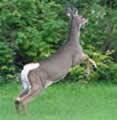
found a site looking out over the river. We went for a walk in the
gloom of evening and found ourselves playing hide'n'seek with a herd
of deer and a flock of wild turkeys, little dinosaurs scurrying
through the forest.
Upper Canada, a collection of old buildings from the St
Lawrence valley. It looked interesting, but it was priced as if you
were going to be there all day, and it didn't look that different
from what we've seen elsewhere. We needed to find a campsite and we
chose the bird sanctuary on Nairn Island. The sanctuary had massive
flocks of Canada geese, but the campground was almost empty and we
found a site looking out over the river. We went for a walk in the
gloom of evening and found ourselves playing hide'n'seek with a herd
of deer and a flock of wild turkeys, little dinosaurs scurrying
through the forest.
Tuesday September 20th
The morning looked horrible: dark
and windy with waves crashing on the beach, but once we'd crawled
outside we found that it was still warm. As we left the park I
noticed a plaque celebrating the 100th anniversary of importing the
first Holstein cow into Canada. This was an emotional moment for
Sandie as some of her first friends in life were Holsteins.
We continued downriver on the
Long Sault Parkway, which took us from island to island, an
interesting drive. We found out that this part of the river is not
natural. It used to have a lengthy series of rapids (a long sault),
impossible to navigate, but in the 1950s a dam and series of locks
were built at Cornwall, submerging the rapids and seven villages.
Some of the houses were moved to higherground and others were bought
by the government and they became part of the Upper Canada village
we'd seen the previous day. The dam was an important part of the St
Lawrence Seaway, enabling large sea-going ships to get into Lake Ontario.