2004/03 Tasmania loop - Tahune forestry park |
|||
For that night we were headed to Tahune forestry park, which is quite close as the crow flies or the fish swims, but there’s no driveable route along the river, and it’s over two hundred miles by road. We had to drive back past Field (for another Devonshire tea, this time with home-made raspberry jam) and through Hobart, Tasmania’s capital city. Being a Sunday evening, traffic was light and we made good time down south through Huonville and Geeveston, a forestry town.
Tahune is deep in the forest in the mountains behind Geeveston, and we arrived there just before dark. It had a strange little campsite and some very odd bathrooms, but it was free.
Monday March 22nd
Monday was sunny with a cold wind, so we were in no rush to go up to the Tahune Airwalk. The 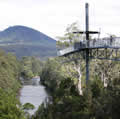 walk is a metal walkway, over a hundred feet high, about fifteen floors, above the forest floor, with views of the Huon and Picton rivers. Even so it was still only halfway up the tallest trees, which here were stringybark gums, not quite as tall as the swamp gums.
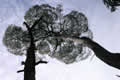
We had a great view of all the trees we’d been gazing up at for the last couple of weeks: sassafras, stringybarks, myrtles, blackwoods, and celery-top pines. Just about all these trees yield beautiful woods. Tahune seems amazingly popular, though most people just seemed to get a thrill out of walking so high above the ground. Very few were there to actually look at the trees.
 |
Tahune Walk (8.12) |
 |
|---|
Tahune is run by Forestry Tasmania, part of their public relations campaign I assume. Their café was packed wall to wall so it seems to be a successful campaign.
There was also a ground-level trail that took us to some “young” huon pines. These were quite small trees and “only” about four hundred years old. The biggest trees, well over a thousand years old, are all gone from this area, converted into British sailing ships. The huon pine wood doesn’t rot, nor is it susceptible to wood borers, so its discovery was a big deal back in the 1800s. 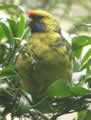
There were a bunch of parrots enjoying the trees and they turned out to be green rosellas, also unique to Tasmania.