2003/05 Prague and Sussex trip - Karlstejn and Staré Mësto |
|||
Sunday was my only completely free day, so, as I wanted to see some of the countryside, I decided to visit Karlstejn Castle, to the south of Prague. I took the metro to Smichov and then the train to Karlstejn. This was a little tricky as I speak no Czech and very few people outside of the tourism industry speak any English. For years, their second language was Russian but I think they’re glad to forget it now.
Czech is what is called a “synthetic language”, with word endings changing according the word’s role in the sentence. So it’s rather like Latin, but the vocabulary is Slavic with few similarities to Latin. There are lots of accents on letters that affect how they are pronounced. Some of them I’ve included in place names in here but I couldn’t do all of them as this computer doesn’t understand Czech any more than I do.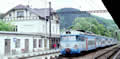
The metro sounded just like the London Underground, but the carriages were taller and mostly new. The train, in contrast, was somewhat old and tired, obviously heavily used, as, even now, most Czechs don’t have cars.
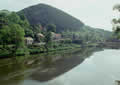
The train followed the river Vltava through pretty countryside, making lots of stops at somewhat decrepit little stations with grass growing on the platforms. I got off at Karlstejn and followed the road to the bridge over the river and then into the village. Just like our outings to Arundel Castle some fifty years ago!
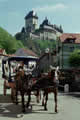
The village was pretty, with red-roofed houses tucked into the forest, but it’s definitely a tourist spot as every other house is selling souvenirs or Bohemian crystal. The castle towered over the village, at the top of a very steep road. It was in a spectacular spot, obviously built around the mountain, as the courtyard had walls that were a mixture of stones and the original rock. It was a series of interconnected towers, very different from the average English castle. It was built by Charles (Carol) IV in about 1350 to keep his relics (bits of saints) and crown jewels safe.
I took the “English” tour, so I got to mingle with a tour group. I was probably the youngest person in the group so negotiating all the stairs took a long time. Our guide was a young Czech student whose knowledge of English was limited to what she’d memorized for the commentary, so asking questions wasn’t too productive. “Ze walls are covered with semi-precious stones”. “What are the semi-precious stones?” “Zey are semi-precious stones.” I think they might have been Carnelian. Originally there were whole walls covered with these stones, held together with gilded plaster. Actually, there wasn’t much inside the castle. “This was Charles IV’s bedroom, but the Prince of Somewhere came to visit in Seventeen Something, and took Charles’s bed as a souvenir. We were left with a few pieces of furniture and a lot of paintings of Charles’s relatives.
One member of the tour party turned out to be an Old Varndeanian from the 1930s, now living in Bristol. We’d even shared the same headmaster, albeit twenty years apart.
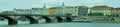 I ate lunch in the village, outside in the sunshine, and then wandered through the shops until the rain came and I hurried back to the station. Back in Smichov it was dry so I decided to walk across the city to my hotel. I followed the Vltava River, and found myself on the marathon course. It turned out that this was the day for the Prague Marathon. There were still a few runners coming through, the 5-6 hour crew, old guys like me closely followed by expectant ambulances.
The buildings along the river were really beautiful and well kept, with brightly painted walls and red tile roofs, and I had begun to believe these stories about Prague being the most beautiful city in Europe. 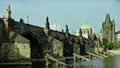 Even though the Czechs have had a terrible time with the Nazis and the Russians, the city survived well with no bombing or shelling, so all the old buildings are still intact. Even the Russians left the city alone and built just a few ugly concrete boxes, mainly in the suburbs.
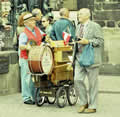 I crossed the river and came to the Charles Bridge, which is the most famous image
 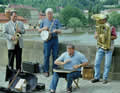 of Prague. It’s a pedestrians-only bridge, with a statue every few yards, and on sunny Sunday afternoons, it is packed with artists, bands, magicians, tourists, and, apparently, pickpockets, a very lively spot.
From there, I wandered through the Staré Mësto, the old town. There were lots of statues, but they seemed to portray more artists, playwrites, and 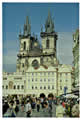 martyrs than soldiers and kings. Nothing wrong with that, and the Czechs have their share of artistic people: Dvorak and Kafka being the best known.
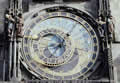
Town Square was pretty with churches and old buildings and outdoor cafes, but a real mess with all the garbage from the marathon, which had finished there earlier. My hotel was in the Nové Mësto, just a few minutes walk away.